Please press the “Play Arrow” (below, left) to listen to the free-flowing audio for this blog

The majority of foundational leadership skills seem quite easy to understand and to implement sustainably.
However, the learning process and content completely changes once you reach an “Above Average” or “Exceptional” Leadership Performance Level.
Why?
It’s actually somewhat simple to comprehend, if / once we reach two key transitional development points of leadership performance.
Let’s take a look at these two transitional points; we’ll refer to them as Tier #2 and #3 (while Tier #1 is the original tier that everyone starts in), by using a basic 0 to 100 scale, with 100 being the theoretical “Perfect” performance level.
Tier #1 – 0 to 68 – Our leadership learning and implementing skills develop basically upward from 0 in a linear line. We learn, we do, we adjust, we get better, etc., until we reach the 68th percentile performance level (or “cap out” below this level). We can sync Tier #1 with the standard, objective Bell-Curve. Thus, if we reach a 68.1, we’re in the Top-32% in leadership performance.
“The Paradoxical Commandments”
People are illogical, unreasonable, and self-centered.
Love them anyway.
If you do good, people will accuse you of selfish ulterior motives.
Do good anyway.
If you are successful, you will win false friends and true enemies.
Succeed anyway.
The good you do today will be forgotten tomorrow.
Do good anyway.
Honesty and frankness make you vulnerable.
Be honest and frank anyway.
The biggest men and women with the biggest ideas can be shot down by the smallest men and women with the smallest minds.
Think big anyway.
People favor underdogs but follow only top dogs.
Fight for a few underdogs anyway.
What you spend years building may be destroyed overnight.
Build anyway.
People really need help but may attack you if you do help them.
Help people anyway.
Give the world the best you have and you’ll get kicked in the teeth.
Give the world the best you have anyway.”
― Kent M. Keith, The Silent Revolution: Dynamic Leadership in the Student Council
Tier #2 – 68.1 to 84 – Our learning and implementing skills now shift from a linear line to a moderately curved, exponential line. The amount of effort to move from a 68.1 to an 84 will be greater than the amount needed to move all the way from a 0 to a 68!
The development slope changes from linearly to exponentially, simply due to the complexity, ambiguity and difficulty of our development at this level. Again syncing Tier #2 with the standard, objective Bell-Curve, if we reach the 84th percentile, we’re in the Top-16% in leadership performance.


Tier #3 – 84.1 to 100 – This exceptional leadership performance is reserved for the Top-16%, again, following the standard, objective Bell-Curve. We could further stratify this top tier, but won’t at this time.
Our learning and implementing skills now shift from a moderately curved exponential line to a significantly steep exponential curve. The amount of effort to move from a 84.1 to just 90 or from 90 to 91, will be greater than the amount of effort needed to move all the way from a 0 to a 68.
Fascinating Dynamic: Once we reach 90, the Exceptional Paradox Curve shifts into full-gear. Nearly everything we’ve learned up to this point, won’t get us just 1% better. Thus; getting better requires fully embracing a paradox at each and every turn.
Professional Example: The more you “release” the stronger your organization gets (if you’re in the right organization).
Personal Example: The more you love someone, the less you attempt to control the person; and then, the more they love you in return (if they’re the right person for you).
Here’s some basic, objective math: only 16% or 80 of the Fortune 500 CEO’s are in “Above Average” or “Exceptional” performance levels. Thus, 420 of the Fortune 500 CEO’s are “Average” or “Below Average”.
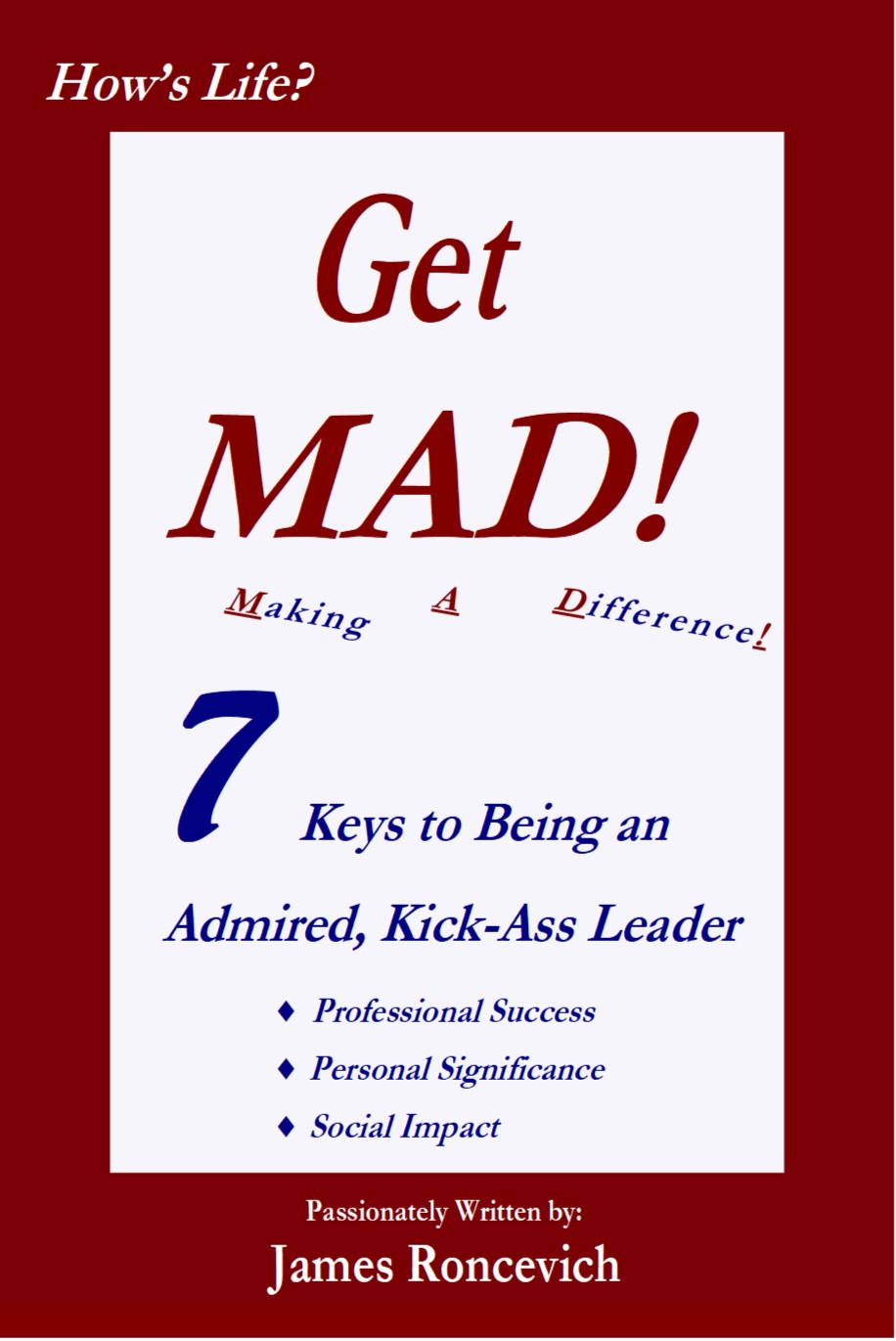
In my leadership book, “Get MAD! 7 Keys to Being an Admired, Kick-Ass Leader” (MAD! is an acronym for Making A Difference!) I hit on these leadership issues and provide multiple qualitative and quantitative metrics to objectively evaluate the C-Suite Leadership against their peer groups, such as the Fortune 500.
Who changes the world? I believe it’s almost exclusively the Top-7%. They are the only ones with the Talent Portfolios and social consciences needed to actually implement significant positive social impact.
If you believe you’re one of these executives, we’d love to explore possible opportunities.
Get Making A Difference! ~ JR