“Your grandfather is and will always be your hero, your inspiration. He fought in World War II, came home to Little Rock, Arkansas, and worked for 50 years as a mailman in the segregated south. Not once did he get a job promotion in five decades. But he kept working all the same.” ~ David Robinson

Inclusion, diversity, etc., are extremely popular PR topics this year.
Why do you believe organizations have increased their communication internally and externally on these topics?
For some organizations it’s genuine while for many, it’s simply a proactive way to put on a Kevlar vest to protect themselves against negative PR.
Have most organizations actually changed at their core, beyond what is perceived to be mandatory, in order to continue doing business as close to “as usual”?
The simple answer regarding whether or not organizations have actually changed, lies in the answer to the question, “have the Executives (who were there prior to the theoretical change) left the organization”? If the executives haven’t left and are still in power, odds are, nothing much has changed beyond what they now perceive as being the necessary, minimum required changes.
Therefore, “great, okay or not-so-good” things are likely to continue at the organizations, based on the Collective-DMQ of the Executive Team.
So… who usually gets promoted?


Source: “Get MAD! 7 Keys to Being an Admired, Kick-Ass Leader” – Figure: 1-4
Let’s keep this complex topic as succinct and simple as possible (for purposes of this blog, whereas a multi-dimensional approach is taken when working with clients) by starting with Hiring Decision Makers who have a DMQ of 8.4 or lower (scale = 0.0 to 10.0, with 10.0 = theoretically perfect). Here’s who’s likely to get hired.
- People who have a DMQ that is perceived to be almost as high or lower than the hiring decision maker’s DMQ
- People who have been or are believed to be aligned with the hiring decision maker’s style of management (e.g. micro-management, technical competence, in-the-box-thinker, loyal regardless if “right”, etc.)
- People who “check all the cover-your-ass” boxes. This is in case it doesn’t work out, the hiring decision maker had a solid, organizationally accepted justification for hiring the person (e.g. education level, years of experience, etc.) even if it doesn’t turn out well.
So… who usually doesn’t get promoted?
- People who have a DMQ that is perceived to be as high or higher than the hiring decision maker’s DMQ
- People who demonstrate “best industry solution” approaches, but these solutions are not “in-the-box” of the hiring decision maker and involve some risk (vs. “safe solutions” traditionally used by the organization).
- People who don’t “check all the cover-your-ass” boxes, in case it doesn’t work out. Thus, the hiring decision maker may be viewed as making a poor hiring decision without a solid “acceptable” justification for hiring the person if it didn’t turn out well.

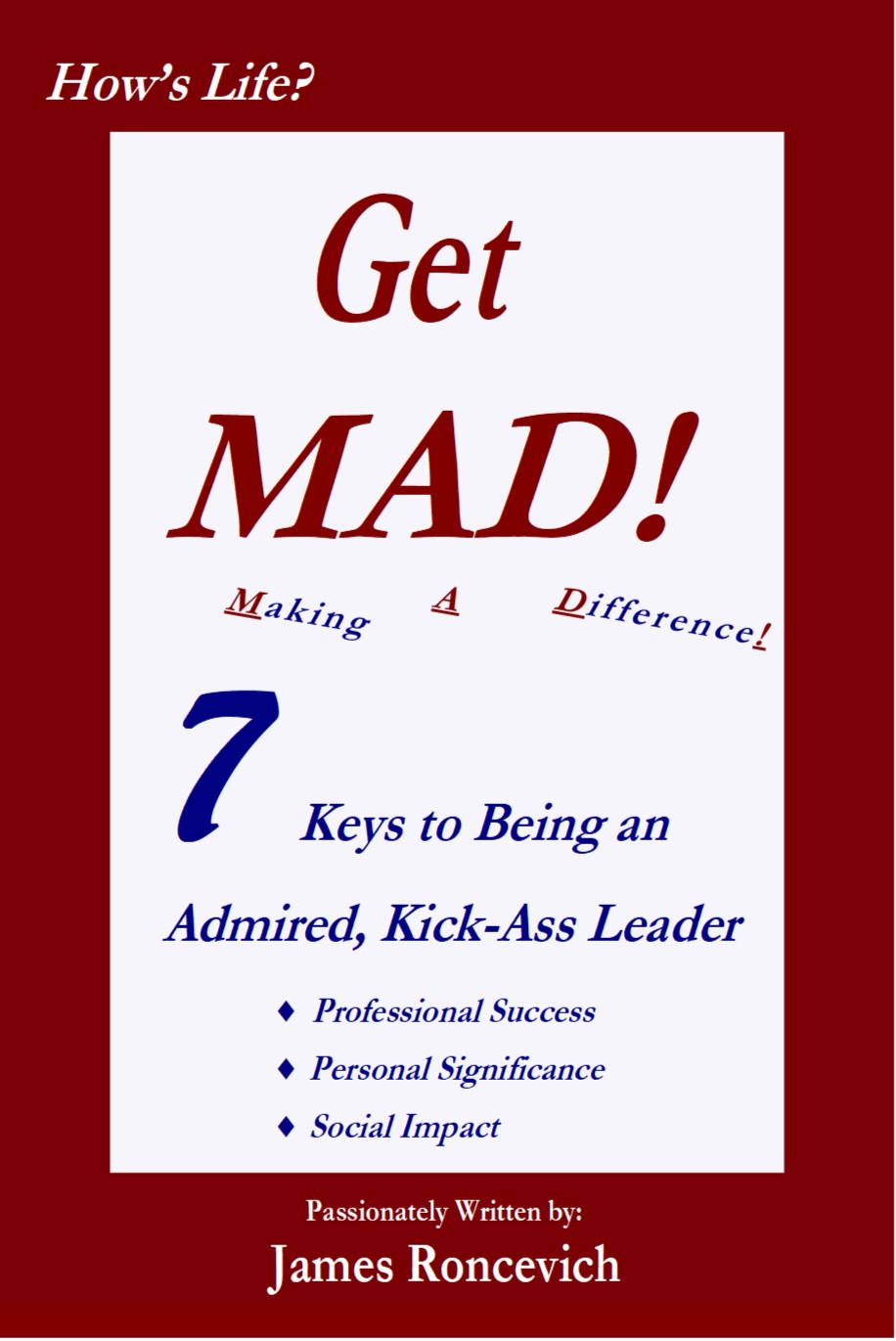
When designing Talent Acquisition, Promotion, Compensation, etc., models, this area of an organization can simply be the highest impact opportunity for those that “get it right”. I go into the hiring process with a moderate level of detail in my book, “Get MAD! 7 Keys to Being an Admired, Kick-Ass Leader”.
Now; we have left, the rare group of 8.5+ leaders, who follow this simple rule… hire / promote the best talent for today and more importantly tomorrow, that makes your organization better! Clearly, diversity and inclusion are key elements in determining who will make your organization better. If you haven’t figured this out yet; there are numerous studies available.
Objectively, as a leader, how good at hiring talent… are you really?
If you really want to know how good you are, use the models in my book to rate yourself, your organization, etc., objectively!
Q: What do 8.5+ Leaders also do exceptionally?
A: They make significant differences at work, home and in their communities!
Are you actually an 8.5+ Leader? If “Yes”, keep reading!
Why wouldn’t a Corporation want to save $25+ Million and be willing to donate 10% or $2.5+ Million to the Non-Profits of their choice, from this New, Realized Net Income, that is currently and will just continue to be forfeited, if they don’t collaborate with our Social Impact Teams?
If you’re reading this and you’re a “Get’s It Leader” that wants to make a Significant Social Impact in the most intelligent way… DM me on LinkedIn or directly (jim.roncevich@ipgsocialimpact.com).
Are you done talking about it and ready to get started?
Together; we can raise $ Millions for your favorite Charity while actually (vs. hoping) changing 1,000’s of lives?
Simple! Significant! Swift!
Who changes the world? I believe it’s almost exclusively the Top-7%. They are the only ones with the Talent Portfolios and social consciences needed to actually implement significant positive social impact.
If you believe you’re one of these executives, we’d love to explore possible opportunities.
.
Get MAD! Get Making A Difference! ~ JR